Why Kubernetes API Server hardening matters for Cybersecurity
The Kubernetes API Server is the control plane entry point, it handles authentication, authorization, admission, and exposes cluster state. Compromising the API Server gives attackers a direct path to create or modify workloads, escalate privileges, and exfiltrate data. For Cybersecurity teams and sysadmins, hardening the API Server is foundational to reducing blast radius and meeting compliance objectives.
This checklist focuses on concrete, production-ready changes, exact kube-apiserver flags, audit policy snippets, RBAC commands, and network controls. Follow the steps, test in staging, and automate enforcement with configuration management.
Prerequisites and threat model
Define the threat model first, including insider risks, compromised nodes, and external network attacks. Inventory control plane hosts, etcd endpoints, and the service accounts that interact with the API. Ensure you have access to the control plane machine or the manifests that populate the kube-apiserver systemd unit or static pod.
Required tools include kubectl with cluster-admin access for testing, openssl or cfssl for certs, and a method to edit control plane manifests such as SSH access to masters or access to the kubeadm manifests under /etc/kubernetes/manifests.
Secure TLS and certificates
Always enable TLS for the API Server and for etcd. Use certificates signed by an internal CA, rotate certificates before expiry, and enforce client certificate authentication where possible. Example flags to set in the kube-apiserver manifest include:
--tls-cert-file=/etc/kubernetes/pki/apiserver.crt
--tls-private-key-file=/etc/kubernetes/pki/apiserver.key
--etcd-cafile=/etc/kubernetes/pki/etcd/ca.crt
--etcd-certfile=/etc/kubernetes/pki/apiserver-etcd-client.crt
--etcd-keyfile=/etc/kubernetes/pki/apiserver-etcd-client.key
--insecure-port=0
Protect private keys with strict filesystem permissions, and automate certificate issuance and rotation with cert-manager or an internal PKI pipeline.
RBAC, API access controls, and service accounts
Enforce RBAC authorization, avoid cluster-admin for day-to-day automation, and limit service account secrets. Enable RBAC explicitly with the kube-apiserver flag and audit existing bindings.
--authorization-mode=Node,RBAC
Use least privilege roles, and tighten existing RoleBindings and ClusterRoleBindings. Example to list wide bindings and a command to revoke a risky binding:
kubectl get clusterrolebinding --all-namespaces
kubectl delete clusterrolebinding
Admission controllers and API request validation
Admission controllers enforce policies at object creation time. Enable the critical controllers in the kube-apiserver and add policy webhooks for image validation and PodSecurity. Typical enabled controllers include DefaultStorageClass, PodSecurity, NodeRestriction, and ValidatingAdmissionWebhook.
--enable-admission-plugins=NodeRestriction,PodSecurity,DefaultTolerationSeconds,DefaultStorageClass,ValidatingAdmissionWebhook
Deploy a validating webhook for image provenance, or use OPA Gatekeeper for policy as code. Implement PodSecurity standards to prevent privileged containers and enforce allowed capabilities.
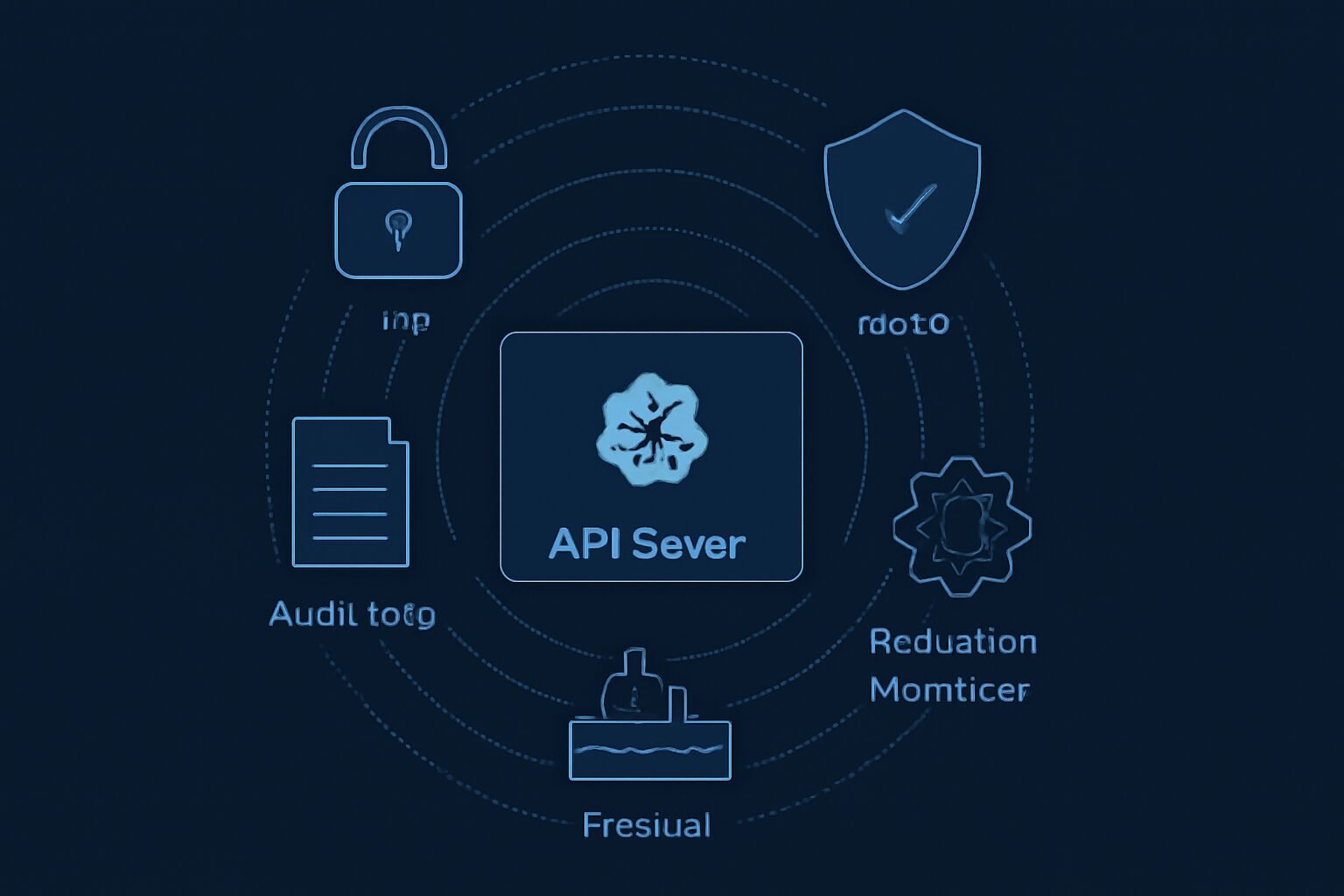
Audit logging and API server flags
Enable structured audit logging and a policy file that captures high risk events such as create, update, and delete on pods, secrets, and roles. Example kube-apiserver flags include:
--audit-policy-file=/etc/kubernetes/audit-policy.yaml
--audit-log-path=/var/log/kubernetes/apiserver-audit.log
--audit-log-maxage=30
--audit-log-maxbackup=10
--audit-log-maxsize=100
Use an audit policy that records metadata by default and requestBody for write operations on sensitive resources. Forward audit logs to a central SIEM for retention and alerting.
Kubelet authentication and authorization
Secure kubelet endpoints and require client certificates or token authentication. Configure the API Server to use a dedicated client cert when contacting kubelets, and ensure kubelet server TLS is enabled on nodes.
--kubelet-client-certificate=/etc/kubernetes/pki/apiserver-kubelet-client.crt
--kubelet-client-key=/etc/kubernetes/pki/apiserver-kubelet-client.key
--kubelet-preferred-address-types=InternalIP,ExternalIP,Hostname
Limit kubelet permissions via NodeRestriction and avoid granting broad credentials to workloads that could call the kubelet API.
Network controls and API server exposure
Place the API Server behind a hardened load balancer or a jump host, and restrict access with firewall rules to known management networks. Do not expose the control plane to the public internet without additional protections such as a bastion, MFA, and strict IP allow lists.
- Allowlist management IPs at the network layer
- Use TLS mutual authentication for etcd and API server to prevent MITM
- Run API server on private subnets with limited route tables
Use network policy and host firewall rules on control plane hosts to limit outbound connections, and monitor for anomalous API client behavior.
Operational hardening and rate limits
Apply API rate limiting flags to prevent request flooding and DoS against the control plane. Set conservative values initially and tune based on observed load. Example flags:
--max-requests-inflight=400
--max-mutating-requests-inflight=200
--request-timeout=1m
Automate backups of etcd, test restores regularly, and implement alerting for control plane health. Maintain minimal uptime windows for sensitive updates, and use canary or staging clusters before rolling changes to production.
FAQs
Below are common operational and security questions when hardening the Kubernetes API Server. These answers focus on actionable steps and references for further investigation.
- Q: Should I disable anonymous access to the API Server?
A: Yes, set –anonymous-auth=false and use strong authentication backends such as client certificates, OIDC, or an external identity provider. - Q: How do I limit service account token scope?
A: Use projected service account tokens and create Roles with minimal permissions. Consider bound tokens via TokenRequest API for short lived credentials. - Q: Is etcd encryption necessary?
A: Encrypt secrets at rest using Kubernetes encryptionProviders with a KMS provider, and ensure etcd TLS is enforced for client and peer communications. - Q: How often should I rotate cluster certificates?
A: Rotate before expiry and automate rotation. Many teams use a 90 day window, with automated monitoring and renewal pipelines.
Keep documentation of current configurations and change history to support audits and incident response.
Conclusion
Hardening the Kubernetes API Server is a multi layer process that combines cryptographic protections, strict authorization, runtime policy enforcement, logging, and network isolation. The checklist above provides precise kube-apiserver flags, audit configuration, RBAC commands, and operational controls that you can apply to a production cluster. Start by enforcing TLS and disabling insecure ports, enable RBAC and NodeRestriction, and roll out admission controllers and audit logging. Pair those changes with network allow lists, rate limits, and automated certificate and secret rotation.
Operational practices such as regular etcd backups, tested restores, log forwarding to a SIEM, and routine review of ClusterRoleBindings reduce risk and speed incident response. Test each change in staging, monitor control plane metrics after each adjustment, and document rollback steps. Treat the API Server as a critical asset, apply defense in depth, and use automation where possible to keep the configuration consistent across control plane nodes. Following this practical checklist will substantially reduce attack surface and improve the security posture of your Kubernetes control plane.